

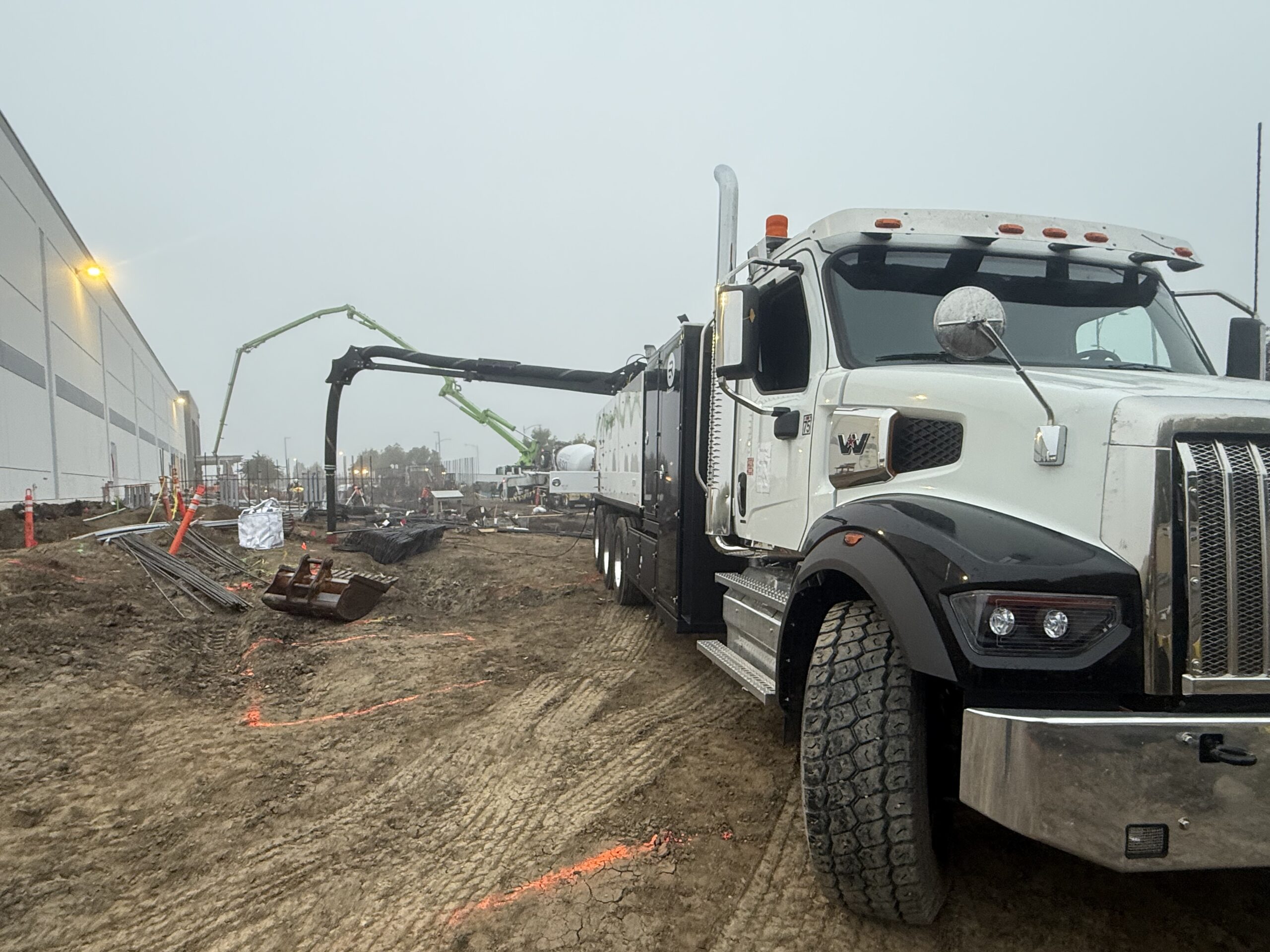
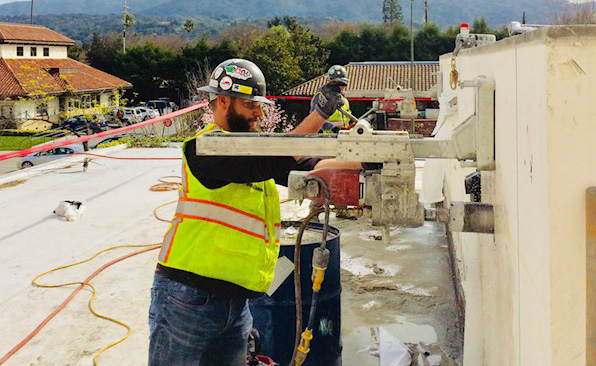
Hydro excavation is a non-destructive digging method that uses pressurized water to loosen soil and a high-powered vacuum system to remove it safely and precisely.
Unlike traditional mechanical excavation, hydro excavation minimizes the risk of damaging underground utilities such as gas lines, water pipes, and fiber-optic cables. It is commonly used for utility locating, potholing, trenching, and work in congested or sensitive environments where accuracy, safety, and minimal surface disruption are critical. By reducing utility strikes, labor requirements, and site restoration costs, hydro excavation improves jobsite safety, accelerates project timelines, and supports regulatory compliance.
What Is Hydro Excavation? Exploring the Safer, Smarter Method for Digging
Hydro excavation is a non-destructive digging method that uses high-pressure water and a powerful vacuum system to break up soil and remove it with precision. Unlike traditional mechanical excavation, which relies on heavy equipment and direct ground contact, hydro excavation minimizes the risk of damaging underground utilities, pipes, and cables.
In recent years, urban density, aging infrastructure, and stricter safety regulations have pushed construction companies to rethink how they dig. The industry demands higher accuracy, reduced liability, and minimal disruption to surrounding environments—conditions that hydro excavation consistently meets.
For contractors navigating utility-laden landscapes or tight urban job sites, understanding hydro excavation isn’t optional. It speaks directly to productivity, project safety, and reduced repair costs. Curious how it works and why it’s outperforming the backhoe? Keep reading.
How Does Hydro Excavation Work?
Hydro Excavation in Action: Breaking Ground Without the Impact
Hydro excavation begins with the targeted application of high-pressure water. This stream cuts into soil layers, effectively loosening the material without disrupting infrastructure below the surface. Operators direct water through specialized nozzles, which control both the intensity and angle of flow to ensure precise excavation.
Soil Removal with Industrial-Grade Vacuum Systems
Once the soil is liquefied, a powerful vacuum system handles the extraction. This system generates enough suction force to pull up the slurry—comprising loosened soil, water, and any surface debris—through a heavy-duty hose positioned over the dig site.
This material travels directly to the vacuum truck, where it’s deposited into an onboard debris tank. This immediate filtration and containment process eliminates delays and keeps the work zone clear of excess material.
Core Components Powering the System
- High-Pressure Water Nozzles: Engineered to penetrate everything from soft clay to frozen ground, these nozzles regulate water output with precision.
- Flexible Hoses: These deliver the water to the excavation site and transport the debris to the storage tank, designed to endure high pressures and heavy loads.
- Industrial Vacuum Unit: This unit creates the suction necessary to lift wet material from the ground and into the tank. Performance is measured by cubic feet per minute (CFM) and inches of mercury (Hg), often exceeding 4,000 CFM and 28 inHg respectively.
- Debris Holding Tank: Mounted on a hydro excavation truck, this component receives and stores the slurry for secure transport to disposal or recycling facilities. Capacities typically range from 800 to 2,000 gallons.
Would a traditional excavator be this precise? Not quite. This method excels in sensitive environments where accuracy, cleanliness, and minimal disruption define success.
Hydro Excavation vs. Traditional Digging: A Clear-Cut Comparison
Traditional Excavation: A Look at Common Methods
Before hydro excavation gained prominence, crews relied heavily on mechanical and manual digging techniques. These included backhoes for broad excavation, trenchers for narrow paths, and hand digging for tight or sensitive spots. While effective in many situations, these approaches tend to lack precision and present higher risks of subsurface damage.
Trenching machinery moves large volumes of soil quickly but comes with considerable tradeoffs—disruption to surrounding areas, potential utility strikes, and greater labor intensity. Hand digging offers more control but drastically slows productivity, particularly in dense or frozen soils.
Hydro Excavation Advantages Over Conventional Methods
- Precision That Protects Infrastructure: High-pressure water allows hydro excavation crews to expose buried lines without contact. Utility strikes drop significantly. A study by the Common Ground Alliance in 2022 found excavation damage accounted for 29% fewer incidents when vacuum excavation replaced mechanical digging.
- Fewer Injuries and Lower Labor Requirements: Traditional methods often place crews close to moving equipment or force them into unstable trenches. Hydro excavation minimizes these hazards. One or two operators can manage most jobs from a safe distance using a hose and control system, reducing both headcount and exposure.
- Performance in Every Soil Type: Mechanical tools hit limits in frozen ground and clay-dense layers. Hydro excavation cuts through permafrost and compacted soils without need for specialized attachments. By using heated water, crews can maintain production even in sub-zero conditions, something backhoes can’t match without modification.
Which Method Fits Your Project Better?
Match technique to task—need fast, controlled excavation near buried fiber or gas? Choose hydro. Isolate digging in a crowded utility corridor? Vacuum excavation handles it with care and detail. For open rural excavation without utility maps, traditional machinery might still carry the edge in raw output. But in any complex or urban setting, hydro excavation delivers a level of accuracy, speed, and safety that traditional methods can’t match.
Key Benefits of Hydro Excavation for Construction Projects
Precision Digging for Foundations, Trenching, and Repairs
Hydro excavation delivers pinpoint accuracy that traditional mechanical digging methods can’t match. Whether shaping footings for a commercial foundation, cutting narrow utility trenches, or accessing compromised infrastructure for repair, this method creates clean, controlled cuts. The water’s high-pressure stream breaks up soil without harming adjacent structures or underground assets. As a result, engineers and site managers gain better control over project depths, widths, and excavation paths—especially valuable in congested urban sites or brownfield redevelopments.
Reduced Surface Disruption and Cleanup
Heavy equipment like backhoes and trenchers tear up pavement, turf, and landscaping. In contrast, hydro excavation only removes the material necessary for the job, leaving nearby areas untouched. This surgical approach minimizes the need for post-project restoration, preserves original surfaces, and reduces damage to driveways, sidewalks, and access roads.
Cleanup is also faster. The debris instantly gets vacuumed into a debris tank, so there’s no pile of spoils to move, manage, or dispose of separately. Fewer secondary trucks, fewer labor hours, and no need to recompact or regrade untouched surfaces.
Accelerated Timelines and Reduced Rework
Delays caused by utility strikes, post-dig adjustments, and unnecessary overcuts often derail timelines. Hydro excavation targets exactly where digging needs to occur, significantly cutting time spent correcting failed locates or backfilling over-excavated areas. Crews work faster since they don’t need constant manual verification of depth or location. In many projects—especially those involving installation of gas, water, or telecom—the time saved can reach 20% to 40% on site prep and utility exposure phases.
Enhanced Compliance with Project Specifications
Architectural and engineering plans demand accuracy to meet load-bearing, elevation, and code-based criteria. Hydro excavation aligns precisely with blueprint-driven cut depths and path layouts. This ensures utilities are placed at proper clearance distances, trench bottoms meet gradient specifications, and excavations avoid zoning boundaries.
Digital locate systems paired with hydro vac units further support compliance by integrating GPS coordinates and measuring depths to the inch. Inspection teams report fewer nonconformance issues and less risk of regulatory rejection or client-required redos.
Minimizing Risk: How Hydro Excavation Enhances On-Site Safety
Fewer Moving Parts, Fewer Injuries
Construction sites carry inherent risks, but hydro excavation removes many of the usual hazards tied to traditional digging. Because the process uses pressurized water and a vacuum system instead of heavy mechanical tools like backhoes or trenchers, there’s significantly less risk of operator injury due to moving equipment or flying debris. Workers remain at a safer distance, and with fewer mechanical interactions, the chance of accidental contact drops sharply.
Reducing the Threat of Utility Strikes
Underground utilities are often difficult to map with precision. Striking gas lines, electrical cables, or fiber optic conduits can lead to explosions, service outages, or electrocution. Hydro excavation dramatically lowers this threat. The high-pressure water can safely expose buried infrastructure without causing damage, allowing excavation teams to work around sensitive zones with full visibility. According to the Common Ground Alliance’s 2022 DIRT Report, utility damages cost the U.S. nearly $30 billion annually—small mistakes cause massive disruptions. Hydro excavation reduces those mistakes.
Greater Stability in Unstable Conditions
Not all digging environments are created equal. Soil can become loose, waterlogged, or unpredictable in congested underground corridors. Traditional machinery doesn’t always adjust well to these changes and can cause cave-ins or sinkholes around trenches. Hydro excavation exerts much less force on the surrounding environment, minimizing soil displacement and maintaining trench wall integrity. In tight spaces packed with underground systems, this gentle excavation method maintains stability while preventing collapses.
- Improved crew safety: eliminates close-quarter mechanical operations.
- Preserved infrastructure: protects underground utilities that could pose severe risks if damaged.
- Controlled excavation: adapts more safely to unpredictable or unstable soil conditions.
Take a moment to consider the last time a routine dig turned unpredictable. Could hydro excavation have changed the outcome? For crews operating in dense urban landscapes or variable terrain, this non-invasive method transforms how safely projects move forward.
Where Hydro Excavation Delivers Precision in Construction Projects
Utility Location and Exposure
Hydro excavation creates clean, controlled access to buried utilities without the risk of physical pipe or cable damage caused by mechanical digging. Construction crews rely on it to expose infrastructure like fiber optic lines, gas mains, water lines, and power conduits before initiating excavation work. Because the high-pressure water loosens soil without blunt force, crews can locate utilities with a tolerance typically under two inches, minimizing rerouting or costly repairs.
In congested underground environments, especially urban corridors, this level of accuracy translates into uninterrupted service and reliable project timelines.
Trenching and Pole Installation
Linear trenching for pipelines, conduit banks, or pole footings benefits significantly from hydro excavation. Rather than cutting broad paths with machinery, crews use hydro vac equipment to dig narrow, deep trenches with smooth walls and minimal soil disturbance. This approach supports safer installations of communication towers, utility poles, and sign posts, especially in areas with overlapping underground systems.
In frozen ground or compacted clay, where traditional trenchers struggle, heated water systems enhance penetration speed without generating harmful vibrations.
Potholing and Daylighting
Also known as test hole excavation, potholing—or daylighting—uses hydro excavation to verify the exact position and condition of underground utilities by exposing them directly. This method aligns with damage prevention policies enforced by agencies like the Common Ground Alliance (CGA), which documents a significant reduction in utility strikes when daylighting precedes mechanical excavation.
Contractors often integrate potholing into pre-construction surveying to avoid line strikes that could delay timelines or trigger regulatory violations.
Debris Removal in Hazardous or Confined Areas
Hydro excavation removes debris without requiring crews to enter tight or unstable spaces. This makes it particularly valuable in culverts, drainage vaults, around bridge footings, or inside facility basements where manual shoveling exposes workers to collapse risks or toxic materials. Water cuts through accumulated materials efficiently, and the vacuum system transfers wet slurry directly into sealed tanks for containment and disposal.
In applications involving environmental hazards—such as asbestos-laden backfill or contaminated soils—hydro excavation limits dust dispersion and operator exposure.
Reducing Utility Strikes Through Precision: The Real Impact on Infrastructure
Minimizing Damage to Existing Utilities
Hydro excavation drastically decreases the probability of striking subsurface infrastructure. Unlike mechanical digging that risks slicing through water mains, high-pressure gas lines, or fiber-optic cables, hydro excavation exposes these utilities with surgical precision. The combination of pressurized water and vacuum suction allows crews to uncover buried assets without physical contact, which nearly eliminates the chance of accidental breakage.
Financial and Legal Implications of Utility Strikes
Damaging underground utilities doesn’t just disrupt construction — it creates ripple effects that extend far beyond the jobsite. According to the Common Ground Alliance’s 2022 DIRT Report, utility damages in the U.S. cost an estimated $30 billion annually, factoring in direct repair costs, delays, traffic impacts, and legal liabilities. Hydro excavation significantly cuts that number by preventing the incidents that trigger these expenses. By avoiding utility hits, projects stay on schedule, eliminate emergency repairs, and reduce exposure to litigation from service providers or municipalities.
Enhanced Visibility Ensures Informed Decision-Making
Hydro excavation creates a clear, visually confirmed exposure area around utilities. Unlike traditional mechanical methods that rely heavily on maps or speculative probing, this approach lets operators visually confirm pipe or cable locations. That transparency allows project managers to make confident decisions in real time, adjusting plans based on what’s actually in the ground—not just what’s on a blueprint.
- Less guesswork means faster progress.
- Operators can avoid unexpected reroutes or stoppages.
- Crews reduce overhead by not having to redo sections disturbed by error.
What does this mean for your project? Fewer utility delays, no emergency repair teams, and a workflow that moves forward instead of constantly pausing to assess damage.
Environmental Impact and Clean-Up Efficiency of Hydro Excavation
Low Emissions and Minimally Invasive Soil Handling
Hydro excavation systems rely on pressurized water and industrial vacuums rather than diesel-powered heavy machinery or mechanical diggers. This method dramatically reduces localized air pollution. According to a study conducted by the Environmental Protection Agency (EPA), non-road diesel equipment contributes up to 48% of construction-related particulate matter. By replacing traditional excavators with hydro excavation units, this percentage drops sharply due to fewer engine cycles and more efficient fuel use.
Dust becomes a secondary concern. Unlike backhoes or trenchers that release dry particulate clouds into the atmosphere, hydro excavation uses moisture to suppress dust at the source. The result is a cleaner site perimeter with lower fine particle dispersion, benefiting both urban air quality and worker respiratory health.
Efficient Containment of Debris
All slurry generated from the process—a mixture of soil and water—is vacuumed directly into a debris tank. This closed-loop handling eliminates the need for temporary spoil piles, reducing the likelihood of contaminated runoff or illegal dumping. It also simplifies transport to designated disposal facilities. Do you see how this changes the logistics?
On sites adjacent to waterways or within environmentally sensitive zones, the ability to contain every ounce of displaced material prevents buffer zone breaches and fines associated with sediment pollution. Compliance becomes easier when cleanup operates within a sealed system.
Preserved Soil Structure and Ecosystem Integrity
Mechanical excavation frequently displaces topsoil layers indiscriminately, leading to long-term erosion, vegetation loss, and structural instability. By contrast, hydro excavation targets only specific utility lines or trench footprints, leaving surrounding substrates intact. Less soil agitation retains root systems and native compaction, which helps avoid events like stormwater channeling or habitat destruction downstream.
In sensitive zones—wetlands, nature reserves, protected habitats—the minimal footprint offered by hydro excavation can mean the difference between project approval and environmental denial.
Faster, Cleaner Site Restoration
Because soil is neither spread nor compacted across the site, cleanup following hydro excavation requires less time and fewer personnel. There’s no need for heavy grading equipment or post-dig debris collection. Operators can backfill trenches with precision or simply extract slurry for offsite remediation, depending on scope and soil regulation.
- Fewer work hours spent on post-dig cleanup reduce total labor costs.
- Minimal compaction ensures fewer landscaping repairs.
- Job sites return to operable condition more swiftly, boosting project timelines.
Consider the downstream benefits: less replanting, fewer erosion barriers, and no air-monitoring equipment to mitigate dust. Hydro excavation reshapes not just the excavation method but the entire environmental strategy for site development.
Creating Cost-Efficiency Through Hydro Excavation in Construction Projects
Lowering Insurance Premiums Through Reduced On-Site Risk
Hydro excavation drastically minimizes the risk of accidents on construction sites. Unlike mechanical digging, there’s no need for metal arms or sharp-edged tools operating blindly underground. By using pressurized water and a vacuum system, the chance of hitting gas lines, communication cables, or water mains drops significantly. This drop in liability risk translates directly to lower insurance premiums. Insurers factor in safety records and risk mitigation approaches, and contractors using hydro excavation often secure more favorable insurance rates over time.
Avoiding Fines and Repair Expenses from Utility Strikes
Digging blindly costs money. According to the Common Ground Alliance (CGA), accidental utility damages in the U.S. led to an estimated $30 billion in societal costs in 2022 alone—including repair, medical, and emergency response expenses. Hydro excavation’s precise locating capabilities reduce the likelihood of these incidents. By cutting down on accidental strikes, contractors bypass both the immediate repair bills and the legal or administrative penalties that come with damaging protected infrastructure.
Reducing Labor Costs with Leaner Crews
Excavation with shovels or heavy equipment typically requires multiple personnel to operate, supervise, and coordinate. Hydro excavation changes that equation. A vacuum truck operated efficiently by a two-person crew can perform tasks that would otherwise take five or six workers. Fewer hours worked and leaner teams directly reduce payroll overhead, especially in high-wage regions where labor makes up a significant portion of job costs.
Saving Time—and Money—Through Faster, More Accurate Work
Precision eliminates rework. Hydro excavation delivers pinpoint accuracy, which reduces the need for job halts or scope revisions. Projects move forward without delays that stem from correcting over-excavation or waiting on utility locator services to revalidate newly exposed assets. Every minute saved in the field reflects in reduced equipment rental fees, shorter timelines for subcontractor involvement, and faster path-to-billing for completed milestones. That efficiency supports lean project delivery models and maximizes overall profitability.
- Fewer insurance claims = better contractor ratings and eligibility for premium discounts.
- No unexpected utility repair costs boosts forecast accuracy for project budgeting.
- Reduced crew size aligns with labor-saving strategies on tight-schedule builds.
- Accelerated site prep keeps Gantt charts on track and clients satisfied.
Think of hydro excavation not just as a safer digging method, but as a strategy for financial prudence and competitive advantage in modern construction management.
Hydro Excavation Equipment: Tools That Drive Precision
Every successful hydro excavation operation depends on a combination of purpose-built machinery and integrated systems designed to deliver controlled power and efficiency. At the core are hydro excavation trucks, outfitted to manage high-pressure water delivery, powerful vacuum systems, and secure debris containment. These trucks do more than haul—they are mobile excavation units built for accuracy even in the most sensitive environments.
Hydro Excavation Trucks: Combining Water and Vacuum Systems
Hydro excavation trucks balance force and precision. Onboard high-pressure pumps inject water through a lance to dislodge soil, while a high-CFM vacuum system removes the slurry into a sealed debris tank. These trucks can operate in tight urban zones or remote industrial sites by adjusting pressure output and vacuum strength in real time.
Key Components and Their Roles
- Water Heater: In colder regions, frozen ground poses a barrier. A built-in water heater enables operations in sub-zero temperatures by heating the water jet to cut through ice-bound soil.
- Vacuum Pump: This component generates the suction needed to draw the loosened soil and water mixture into the debris tank. Depending on the truck’s capacity, vacuum performance can exceed 6,000–7,000 CFM.
- Debris Tank: Once the material is vacuumed, it’s stored in a sealed tank ranging from 800 to over 2,000 gallons, depending on truck size. The secure storage prevents any spilled contaminants or overflow.
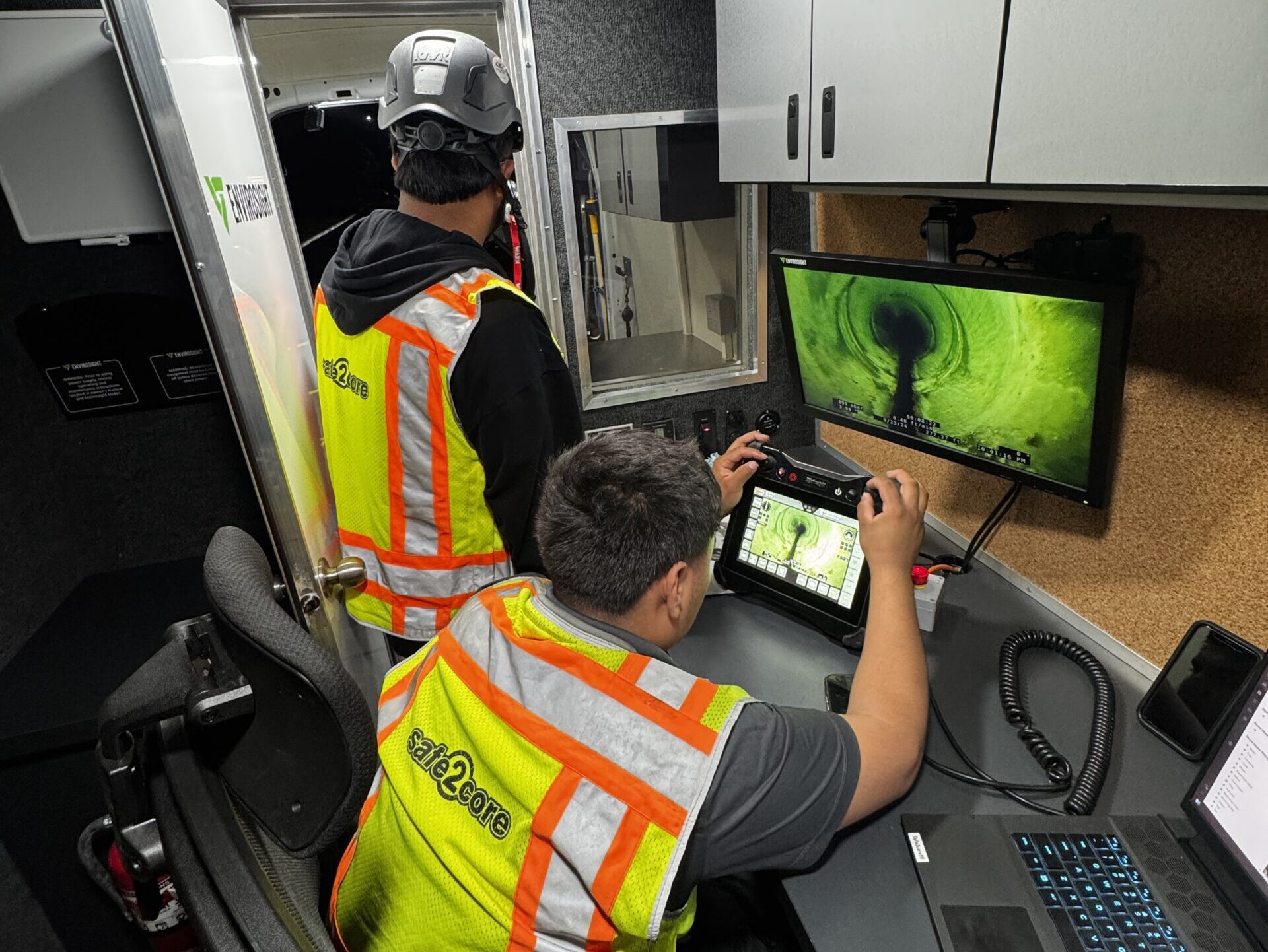
- Control System: Operators manage all functions through an onboard control panel or remote system. Digital interfaces allow precise adjustment of water pressure, temperature, and suction power for variable soil types and excavation depths.
Maintenance Considerations
Routine maintenance extends the operational life and efficiency of hydro excavation equipment. Vacuum filters require periodic replacement, especially in high-dust or clay-heavy zones. Water pumps and jet nozzles need to be inspected for clogs or mineral buildup. Cold-weather systems, particularly boilers and heated hoses, demand off-season servicing to prevent corrosion and cracking.
Fleet owners often implement predictive maintenance software linked to onboard diagnostics. These systems track hydraulic pressure fluctuations, hose wear, and motor hours to schedule service before a breakdown can occur. Downtime not only delays projects but also increases operational cost, so proactive maintenance ensures both uptime and safety compliance.
Navigating Regulatory Compliance and Permitting in Hydro Excavation
OSHA Guidelines: Anchoring Safety in Excavation
The Occupational Safety and Health Administration (OSHA) sets stringent directives under standard 29 CFR 1926 Subpart P to minimize excavation hazards. In hydro excavation, these directives focus heavily on preventing cave-ins, protecting underground utilities, and ensuring safe access and egress.
Because hydro excavation reduces the need for manual digging and heavy machinery near buried utilities, it significantly aligns with OSHA’s goal of reducing trench collapse incidents, which accounted for 39 fatalities in the U.S. between 2016 and 2020. Still, even with this safer method, employers must comply with OSHA requirements for trench safety—including using protective systems like benching or sloping when entering excavation zones deeper than five feet.
811 and Utility Locating Laws: Mandatory Before-Dig Calls
Before launching any hydro excavation project, operators must comply with state-specific utility locating laws governed by the nationwide 811 “Call Before You Dig” service. All 50 states, plus Washington D.C., mandate contacting 811 to initiate a utility mark-out before subsurface work begins.
- Timeline matters: Most states require waiting 48 to 72 hours post-call before excavation can start.
- Ticket management: Contractors must maintain active locate tickets throughout the project duration.
- Tolerance zones: Typically, a 24-inch buffer zone around marked utilities must be exposed carefully—hydro excavation performs this precisely without striking buried assets.
Neglecting to follow these steps can result in civil penalties, liability for damages, and project stoppages.
EPA Oversight: Disposal of Hydro Excavation Slurry
The Environmental Protection Agency (EPA) does not have a direct regulation specifically for hydro excavation slurry disposal. However, facilities must adhere to local and state stormwater management codes and the Clean Water Act (33 U.S.C. §1251 et seq.), which prohibits discharging polluting agents into U.S. waters without a permit.
Hydro excavation generates a slurry composed of water and displaced soil. This material, considered non-hazardous but sediment-rich, requires proper handling:
- Dispose only at approved slurry dumping facilities or solidification yards.
- Implement best management practices (BMPs) to prevent runoff into storm drains.
- Use berms, filter socks, or containment tanks on-site when temporary holding is required.
Local jurisdictions may enforce stricter slurry transport and disposal rules, particularly in urban construction zones or near protected waterways.
Getting Permit Approvals: Tapping Into Local Processes
Permitting for hydro excavation varies by municipality. Some areas classify it under general excavation work, while others require specialty permits tied to water discharge or utility work. Understanding jurisdictional layers—city, county, and state—is necessary to remain in compliance.
Where municipal waste treatment plants accept hydro excavation waste, contractors often need a manifest system to document load origin, volume, and handling procedures. In high-density urban sites, right-of-way excavation permits further dictate work hours and site restoration standards.
Before breaking ground, verify requirements with the local building department and environmental agency. Are there time-of-day restrictions? Required erosion controls? Specific hauling routes? Each permit answers a vital question.
Best Practices for Hiring a Hydro Excavation Contractor
Check Licensing and Verify Insurance Coverage
Begin with the basics. Make sure the contractor holds the appropriate state or municipal licenses to operate hydro excavation machinery. Licensing proves regulatory compliance and ensures that the company meets minimum industry standards. Equally essential is proper liability insurance. Without it, any onsite accidents or equipment damage could fall back on your project’s budget. Request current insurance certificates directly from the provider, not just the contractor.
Evaluate Equipment Specifications and Availability
Not all hydro excavation equipment performs equally. Ask detailed questions—what PSI rating do the water systems deliver? How many cubic feet per minute (CFM) of airflow does the vacuum system handle? Can their equipment operate in freezing conditions, and do they use heated water systems in colder seasons? Availability matters too. If the fleet is limited, you risk scheduling conflicts or delays in service delivery.
Request Proof of Project Experience
Hydro excavation across utility trenches differs from work near delicate fiber optic lines. Ask for case studies or project briefs that align closely with your project’s scope. Have they worked under similar environmental or geological conditions? Do they have testimonials from general contractors or municipal clients? These answers will reveal their adaptability and relevant skill sets.
Scrutinize Safety Records and Training Programs
Hydro excavation prioritizes safety, but execution still depends on the crew. Request OSHA safety record summaries for the past three years. Ask about internal safety audits, required PPE, and ongoing training schedules. For example, do operators hold certifications for confined space entry or utility locating? A contractor investing in safety will produce fewer incidents and smoother daily operations.
Understand Their Approach to Permitting and Compliance
Handling compliance isn’t optional—it’s operational. A qualified contractor should already know the dig laws and permitting procedures for your jurisdiction. Ask who manages the permit application process. How do they handle 811 utility locate coordination? Can they provide documentation proving previous compliance with EPA and municipal codes? You want confidence that project timelines won’t become mired in red tape.
- Licensing and insurance: Demand proof and verify through regulators or insurers.
- Machinery capabilities: Match performance specs to job requirements.
- Relevant experience: Seek contractors with similar scope and conditions.
- Safety standards: Review historical safety records and employee training investments.
- Compliance knowledge: Ensure contractors handle permits and follow jurisdictional rules.
Each question you ask filters out guesswork and pushes your project toward measurable success. Are you asking the right ones?
Overcoming Common Challenges in Hydro Excavation
Cold Weather Excavation Limitations
Frozen ground during winter months restricts the effectiveness of standard hydro excavation equipment. Water freezes on contact with the soil, slowing down or halting excavation entirely. To maintain operations during sub-zero temperatures, specialized heated water systems integrated into the truck or trailer rig keep water temperatures high enough to penetrate frost-bound earth. These systems typically maintain water above 60°C (140°F), enabling successful excavation even in -20°C (-4°F) conditions.
Some crews also deploy antifreeze recirculation systems within the pump and hose lines. This prevents internal freezing and allows for continuous excavation during early morning or overnight shifts.
Navigating Tight or Confined Job Sites
Urban environments, industrial facilities, or congested construction zones often leave minimal space for traditional hydro excavation trucks. In response, contractors deploy compact units or trailer-mounted vacuum systems that maneuver more easily. These smaller rigs usually maintain suction power comparable to full-size models, thanks to high-efficiency positive displacement blowers and optimized hose configurations.
For highly restricted areas, remote hose extensions of up to 200 feet enable crews to park equipment outside the zone and still reach the dig site effectively.
Handling High-Volume Soil Extraction
On large trenching or daylighting projects, the spoil tank on the hydro excavation unit can fill rapidly, leading to repeated downtime for dumping. To streamline operations, contractors integrate directly with spoils transport services. Dump trucks or tandem trailers cycle spoil offsite while the hydro vac unit continues excavation uninterrupted.
Another approach involves custom rigs with extended debris tank capacities—some reaching up to 15 cubic yards—reducing dump frequency and increasing productivity during full-day operations.
Debris Disposal and Legal Compliance
Vacuumed slurry and soil must be disposed of in accordance with local and environmental regulations. Landfilling or unauthorized dumping leads to legal consequences and project delays. Ensuring compliance involves establishing partnerships with licensed waste disposal facilities that accept hydrovac materials.
Many contractors set up pre-approved dump stations near job locations. Some facilities provide dewatering services, separating liquids from solids and recycling water when permitted. This method not only meets disposal regulations but also reduces long-term environmental impact.
Hydro Excavation in Action: Real-World Case Studies That Prove Its Value
Utility Upgrade in a Dense Urban Construction Site
In the heart of Chicago’s Loop, a major telecommunications provider launched a fiber-optic infrastructure upgrade—right beneath one of the city’s busiest intersections. Conventional mechanical excavation would have required road closures, detours, and potentially weeks of disruption. Instead, the project team deployed hydro excavation.
By using pressurized water and a vacuum system, crews uncovered subsurface utilities with minimal surface disruption. This approach not only avoided damaging existing power lines, sewage systems, and communication cables but also reduced excavation time by 39% compared to the projected mechanical method timeline. Surrounding businesses remained fully operational throughout the process.
Highway Trenching with Precise Soil Control
During a Virginia Department of Transportation expansion project on Interstate 95, engineers needed to trench for new drainage systems along a high-traffic corridor. Traditional trenching would have required closing two lanes, disrupting traffic during peak hours.
Hydro excavation allowed teams to trench between lanes without affecting road integrity. The high-precision method limited soil displacement outside the target trench and resulted in a 27% reduction in clean-up efforts post-excavation. Traffic impact dropped to zero—no detours, no added congestion, no delays.
Gas Pipeline Exposure Without Hand Tools
In West Texas, a natural gas provider needed immediate access to a buried pipeline for routine inspection and valve replacement. The region’s history of pipeline strikes made manual digging or mechanical tools a liability.
The crew opted for hydro excavation to expose the pipeline over a 150-foot segment. Water pressure was calibrated to remove soil without harming the pipe’s protective coatings. Within six hours, the entire section had been uncovered, inspected, and reported—with zero physical contact made with the pipeline infrastructure. Compared to the previous year’s hand-dig inspections, the hydro method cut operational downtime by more than half.
- Urban Site Benefit: No road closures, undisturbed utility networks, 39% time savings.
- Highway Project Result: Full-speed traffic maintained, 27% less post-dig site restoration.
- Pipeline Inspection Gains: No tool-to-pipe contact, 50% faster process, risk-free exposure.
Future Trends in Excavation Technology
Automation and Remote Control for Hazardous Sites
Automation is reshaping excavation work, particularly in high-risk environments. Remote-controlled hydro excavation systems are already deployed in zones with contamination, unstable terrain, or extreme weather. These systems reduce human exposure while maintaining precision. Companies integrating robotics into their hydro vac units are seeing reduced labor costs and improved safety records. Expect machine learning and AI to further optimize excavation parameters, adapting to soil types and underground infrastructure in real-time.
Integration with GIS and Utility Mapping
The compatibility between hydro excavation tools and Geographic Information Systems (GIS) is tightening. Excavation teams now upload dig site data directly to GIS platforms, aligning project planning with existing utility maps. This integration minimizes risk during utility exposure and facilitates digital as-built documentation. Engineering firms using cloud-based mapping in conjunction with hydro vac units accelerate their permitting processes and reduce change orders, thanks to greater data precision.
Eco-Friendly Water Recycling Systems
Water usage in hydro excavation has traditionally raised sustainability concerns. New hydro vac truck designs are addressing this with integrated water recycling systems. These closed-loop systems extract debris, filter the water on board, and reuse it for continued excavation. The result: reduced water demand, lowered disposal fees, and extended operation time. In drought-sensitive regions, firms using recycling-enabled trucks meet environmental compliance more easily and capture competitive advantages in public tenders.
Hybrid Systems Combining Vacuum Excavation with Sensor Technologies
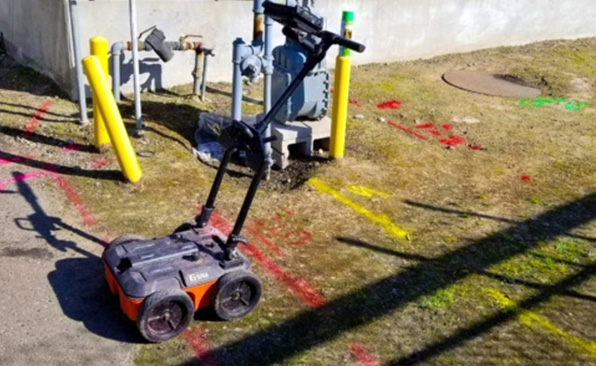
Sensor-packed hydro vac trucks are emerging as multi-role platforms. Ground-penetrating radar (GPR), electromagnetic locators, and thermal imaging units are now part of sophisticated rigs that not only dig but detect. This hybridization enables crews to pinpoint utilities before excavation begins, validate targets mid-process, and document findings without needing separate instruments. In urban construction, where utility congestion peaks, these systems streamline pre-dig assessments and reduce utility strike incidents.
- Remote operation is enhancing crew safety in chemically sensitive sites and disaster-prone zones.
- GIS data layering improves site visualization and traceability for project stakeholders.
- Water recycling tanks are cutting fresh water use—some systems reportedly reuse up to 85% of extracted water.
- Smart sensors embedded in vac nozzles and booms are feeding real-time subsurface data to operators.
These trends are shifting hydro excavation from a specialized alternative to a core component of advanced utility locating and civil excavation workflows. Want to know how your next dig project can benefit? Review how your current equipment aligns with the above advancements.
Why Hydro Excavation Delivers Greater Value to Modern Construction
Hydro excavation consistently outperforms traditional digging methods in speed, accuracy, and risk reduction. By using pressurized water combined with vacuum technology, it eliminates the guesswork and dangers associated with mechanical excavation. Contractors avoid costly utility strikes, reduce environmental disruption, and meet compliance standards more easily—all while maintaining project timelines.
Integrating hydro excavation during the early stages of planning shortens project preparation, helps identify underground conflicts before major equipment moves in, and sets a proactive tone for site management. Teams gain more control over unknowns, and that translates directly to budget protection and fewer rework events.
Ready to put advanced excavation to work on your site? Don’t wait until utility maps become excavation risks. Engage a certified hydro excavation contractor to assess your project’s ground conditions, utility densities, and soil types. Let them match the right tools to your unique requirements before traditional equipment ever hits the ground.
Start safer and smarter – incorporate hydro excavation on your next job site. Contact us today for a quote.
Content ideas